Sleep trackers can be helpful, but they are not medical devices. Here’s how they detect sleep, what “deep” and “REM” really mean, and how to turn s...
Calma Path
October 18, 2026
Updated October 18, 2026
How to Keep a Two-Week Sleep Diary for a Medical Appointment
A simple sleep diary can help your clinician understand patterns in your sleep. Here’s what to record each morning, how to estimate without clock-watching, and what to bring to your appointment.

Written by
Maya Reynolds
Maya Reynolds is a registered nurse turned wellness educator who specializes in translating clinical research into accessible, everyday health habits. She is passionate about helping people sustainably improve their fitness, sleep, and nutrition without the pressure of toxic wellness culture.
If you have ever sat in a medical appointment and realized you cannot clearly answer, “So what time do you usually fall asleep?” you are not alone. When you are exhausted, memory gets fuzzy. A sleep diary takes the pressure off your brain and gives your clinician something much more useful than a one-sentence summary like “I sleep terribly.”
As a former bedside nurse who used to run on adrenaline and caffeine, I also want to say this upfront: a sleep diary is not a test you can fail. It is a practical snapshot. The goal is not perfection. The goal is patterns.

What it is and why clinicians ask
A sleep diary is a daily log of when you think you fell asleep, how your night went, when you woke up for the day, and how you functioned the next day. Clinicians often ask for 1 to 2 weeks. Two weeks is common because it captures workdays and days off, but if you can only manage a week, bring it anyway.
When you bring in your entries, your clinician can quickly see things like:
- How consistent your sleep schedule is
- How long you are likely spending awake in bed
- Whether awakenings cluster at certain times
- Whether naps, alcohol, caffeine timing, or medications line up with rough nights
- Whether your sleep changes on workdays versus days off
This helps guide next steps, such as behavioral strategies, medication adjustments, or whether a sleep study is appropriate.
What to record each morning
Try to fill out your diary once per day, as soon as you reasonably can after waking. You are going for a simple morning record, not a detailed play-by-play.
Core items to track
- Bedtime: when you got into bed intending to sleep
- Estimated sleep onset: when you think you actually fell asleep
- Awakenings: how many times you woke up and rough durations
- Final wake time: when you woke up for the day
- Out of bed time: when you actually got up
- Naps: start time and approximate length
- Medications and substances that affect sleep: sleep aids, pain medications, antihistamines, stimulants, alcohol, cannabis, nicotine, and caffeine timing if relevant
- Daytime impairment: how you felt and functioned, especially sleepiness or dozing
Two quick ratings
If you like scales, add one or two that you can do in seconds:
- Sleep quality (0 to 10)
- Daytime sleepiness (0 to 10)
Consistency matters more than complexity. A “good enough” diary done for 14 days beats a perfect diary that only lasts three.

Estimating sleep without clock-watching
If you struggle with insomnia or anxiety, repeatedly checking the clock can backfire. It can ramp up stress and keep your brain in problem-solving mode instead of sleep mode. The good news is that clinicians expect estimates. They do not need minute-by-minute precision.
Use anchors instead of exact times
- Anchor to your routine: “I turned the lights off after my last bathroom trip,” “I remember hearing the 11 pm train,” “I started a podcast and do not remember it finishing.”
- Round to the nearest 15 to 30 minutes: Your clinician can work with that.
- If you wake at night, avoid checking the time: Instead, estimate duration later. For example: “awake about 20 minutes” or “awake about an hour.”
If you must look at the time
Some people sleep better with a single time reference and worse with repeated checks. If you tend to spiral, try one of these approaches:
- One-check rule: if you wake up and need to use the bathroom, glance once and do not look again.
- Clock out of reach: keep your phone face down and across the room, and use a non-bright alarm clock turned away from you.
If you do end up clock-watching, do not scrap the night. Record what happened and move on. That is still useful data.
A simple two-week diary format
You can use a notebook, a notes app, or a printed sheet. What matters is that it is quick and consistent.
Copy this daily format
- Date
- Bedtime (into bed)
- Lights out (optional)
- Estimated time to fall asleep (minutes)
- Number of awakenings
- Longest awakening (minutes)
- Final wake time
- Out of bed time
- Naps (time and length)
- Sleep-related medications or substances (dose and timing if you know it)
- Daytime impairment (0 to 10 sleepiness, plus a short note like “dozed at desk” or “near-miss while driving”)
- Notes (optional): travel, illness, shift change, unusually high stress, pain flare
Optional, if you like numbers: add “time in bed” and “estimated total sleep.” Your clinician may use those to calculate sleep efficiency (time asleep divided by time in bed). Do not worry about doing the math perfectly.
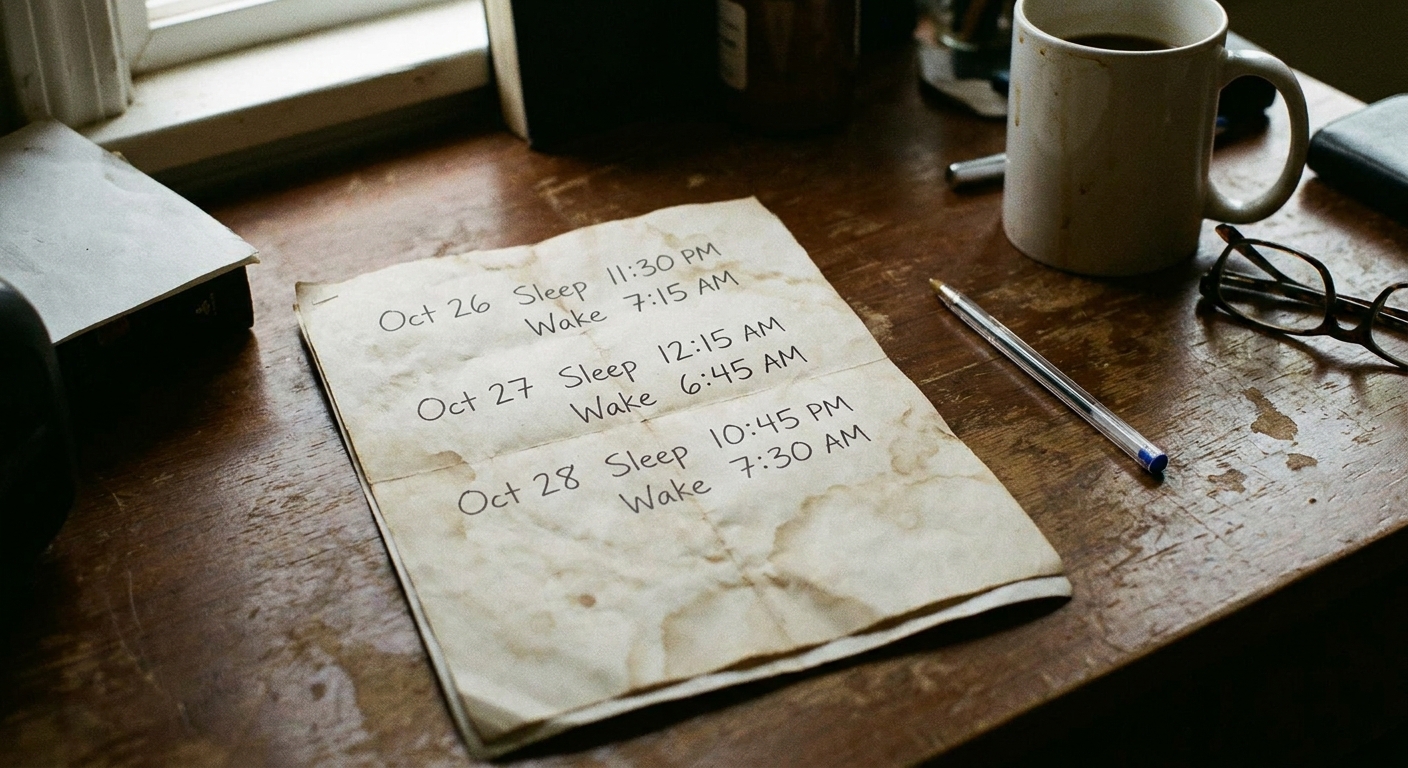
Example entries (filled in)
Mon
Bedtime 10:45 pm, lights out 11:10 pm, time to fall asleep 45 min, awakenings 2, longest awakening 30 min, final wake 6:20 am, out of bed 6:40 am, naps none, substances: coffee 2 cups by 9 am, alcohol none, daytime sleepiness 6/10 (dozed on couch at 8 pm).
Tue
Bedtime 11:15 pm, lights out 11:25 pm, time to fall asleep 20 min, awakenings 1, longest awakening 10 min, final wake 6:10 am, out of bed 6:20 am, naps 3:30 pm for 25 min, substances: coffee 1 cup at 8 am, daytime sleepiness 4/10 (ok at work).
Wed
Bedtime 10:30 pm, lights out 10:45 pm, time to fall asleep 70 min, awakenings 3, longest awakening 60 min, final wake 5:50 am, out of bed 6:30 am, naps none, substances: coffee at 8 am and 2 pm, antihistamine at 9 pm, daytime sleepiness 8/10 (hard to stay alert driving home, pulled over once).
If you only have energy for five fields, prioritize: estimated time to fall asleep, awakenings, final wake time, naps, and medications or substances.
Shift work and day sleep
If you work nights or rotating shifts, your “night” might happen during the day. That is fine. Log sleep based on when you actually try to sleep, even if it starts at 9 am.
- Still record into bed, estimated sleep onset, awakenings, and final wake, even if the clock times look unusual.
- In your notes, label the shift (for example: “night shift” or “post-call”) so your clinician can separate schedule effects from insomnia patterns.
What to bring to your appointment
Make it easy for your clinician to see the big picture quickly. Bring:
- Your diary (paper, screenshots, or a single note you can hand over)
- A medication and supplement list, including doses if you know them, and when you take them
- Your typical caffeine timing (for example: “2 coffees before 10 am” or “energy drink at 3 pm”)
- Any wearable sleep data if you have it, but treat it as optional supporting info, not the main story
- A short symptom list you want addressed: trouble falling asleep, staying asleep, early waking, snoring, gasping, restless legs feelings, vivid dreams, sleepwalking, nightmares, morning headaches
If relevant, add bed partner observations too: loud snoring, witnessed breathing pauses, choking or gasping, thrashing, or frequent kicking.
If there were unusual circumstances during the week or two you tracked, note them briefly. Examples: travel, illness, a new medication, a major deadline, a new baby, a night shift stretch.
What a diary can and cannot do
A sleep diary is a powerful tool, but it cannot diagnose conditions on its own. Here is why:
- It is subjective by design: you are estimating. That is okay, but it is not the same as measuring brain waves or breathing.
- Different sleep disorders can look similar on paper: insomnia, circadian rhythm disorders, sleep apnea, periodic limb movements, medication effects, depression, and anxiety can overlap in symptoms.
- Some problems happen during sleep without you knowing: breathing pauses, oxygen drops, limb movements, and certain parasomnias may require a sleep study or additional monitoring.
Think of the diary as a map. It shows where the terrain gets rough, and it helps your clinician decide which route to take next.
Tips to make it doable
Make it a one-minute habit
Keep your diary where you will see it in the morning: on your nightstand, by your toothbrush, or pinned to your fridge. Set a gentle daily reminder if that helps.
Do not chase perfect sleep while tracking
Try not to overhaul your routine on day one. If you change everything at once, it becomes harder to interpret patterns. If your clinician asked for a diary before starting a new sleep medication or a major schedule change, follow their guidance.
If you miss a day, keep going
One missed entry does not ruin anything. Fill in what you can remember that morning, leave blanks if needed, and continue.
When to seek help sooner
A sleep diary is appropriate for most people, but some symptoms deserve faster attention. Seek urgent medical guidance if you have:
- Dangerous sleepiness, such as falling asleep while driving or in other unsafe situations
- New, severe insomnia tied to a major mood shift, panic, or thoughts of self-harm
- Violent behaviors during sleep or injuries to yourself or a bed partner
If you suspect sleep apnea, schedule an evaluation promptly, especially if you have severe daytime sleepiness, high blood pressure, or heart disease. If you are unsure, call your clinician. You deserve support before you hit empty.
FAQ
Is two weeks necessary?
Two weeks is a sweet spot and a common request. It is long enough to capture workdays, weekends, and normal variation. If you can only manage one week, bring it anyway. Something is better than nothing.
Should I include dreams?
Only if they are part of the problem, like frequent nightmares, vivid dreams with a new medication, or dream enactment. Otherwise, keep it simple.
What if my wearable says something different?
Wearables can be useful for trends, but they can score quiet wakefulness as sleep, and some devices can misread movement or stillness depending on the algorithm. Bring the data if you want, but prioritize your diary and your symptoms. Clinicians are used to interpreting both.
What if I sleep in two chunks?
Write it down. Some people naturally have split sleep, and some have it due to schedule, stress, or insomnia. Logging it gives your clinician a clearer starting point.
A final note
If you are reading this while running on fumes, I want you to know that keeping a sleep diary is not busywork. It is one of the simplest, most respectful things you can do for your future self: it turns “I feel awful” into information your care team can act on.
Keep it short, keep it honest, and let patterns do the talking.