Build a calmer nighttime routine with 10 evidence-based habits that quiet your mind and set you up for deeper, more restorative sleep.
Calma Path
October 18, 2026
Updated October 18, 2026
4 Breathwork Techniques to Calm Your Nervous System Before Bed
Try four simple, science-informed breathing exercises, including 4-7-8, to support relaxation at night, ease anxiety, and make it easier to fall asleep.

Written by
Maya Reynolds
Maya Reynolds is a registered nurse turned wellness educator who specializes in translating clinical research into accessible, everyday health habits. She is passionate about helping people sustainably improve their fitness, sleep, and nutrition without the pressure of toxic wellness culture.
If your body is in bed but your brain is still sprinting through tomorrow’s to-do list, you are not broken. You are human, and your nervous system learned to stay alert.
Breathwork can be a fast, low-cost way to nudge your system out of fight-or-flight and toward rest-and-digest. The best part is that you do not need a perfect routine or a 30-minute ritual. You need a few minutes and a method that feels safe and doable.

Why breathing can help
Your breathing and your autonomic nervous system are in constant conversation. When breathing becomes slower and steadier, and especially when the exhale is longer than the inhale, your body often interprets that as “we are safe.” That shift can support parasympathetic activity, which is the branch associated with digestion, recovery, and sleep readiness.
Breathwork is not a magic off switch for anxiety, trauma, or insomnia, but it can be a useful on-ramp to sleep by lowering physiological arousal.
A quick note on expectations
For some people, breath-focused practices feel grounding. For others, especially if you have a history of panic attacks or trauma, certain techniques can feel activating at first. If that is you, start with the gentlest option below and keep your breathing comfortable. You never need to push through.
Before you start
- Choose your position: Lying down is fine, but if you get lightheaded easily, start seated with your back supported.
- Keep it nasal if possible: Gentle nasal breathing supports slower, more regulated breathing. If your nose is congested, mouth breathing is okay.
- Think quiet and easy: Breathwork for sleep should feel like turning the volume down, not like training for a race.
- Try 2 to 6 minutes: Consistency beats duration at night.
- Timing tip: If you can, do this after lights are dimmed and screens are off. Even a small shift in light and stimulation helps your body get the message that the day is ending.
Technique 1: 4-7-8
This classic method is popular for a reason. It lengthens the exhale and gives your mind a simple count to follow, which can interrupt spiraling thoughts.
How to do it
- Get comfortable and let your shoulders soften.
- Inhale through your nose for a count of 4.
- Hold your breath gently for a count of 7.
- Exhale slowly through your mouth for a count of 8, letting the exhale feel unhurried.
- Repeat for 4 rounds to start.
Make it sleep-friendly
- If the breath hold feels stressful, shorten it. Try 4-4-6 instead.
- Keep the inhale quiet. Straining to hit the number can backfire.
Best for: racing thoughts, end-of-day overstimulation, trouble transitioning into sleep.
Technique 2: Physiological sigh
The physiological sigh is a simple pattern that many people report helps them downshift quickly. Think of it as a reset you can do between brushing your teeth and turning off the light.
How to do it
- Inhale through your nose.
- At the top of the inhale, take a second small top-off inhale through your nose.
- Exhale slowly and fully through your mouth.
- Repeat for 3 to 5 rounds.
Tip: Keep it gentle. The goal is relief, not a huge breath.
Best for: acute stress, a spike of anxiety, that tight-chested wired feeling right before bed.
Technique 3: Belly breathing
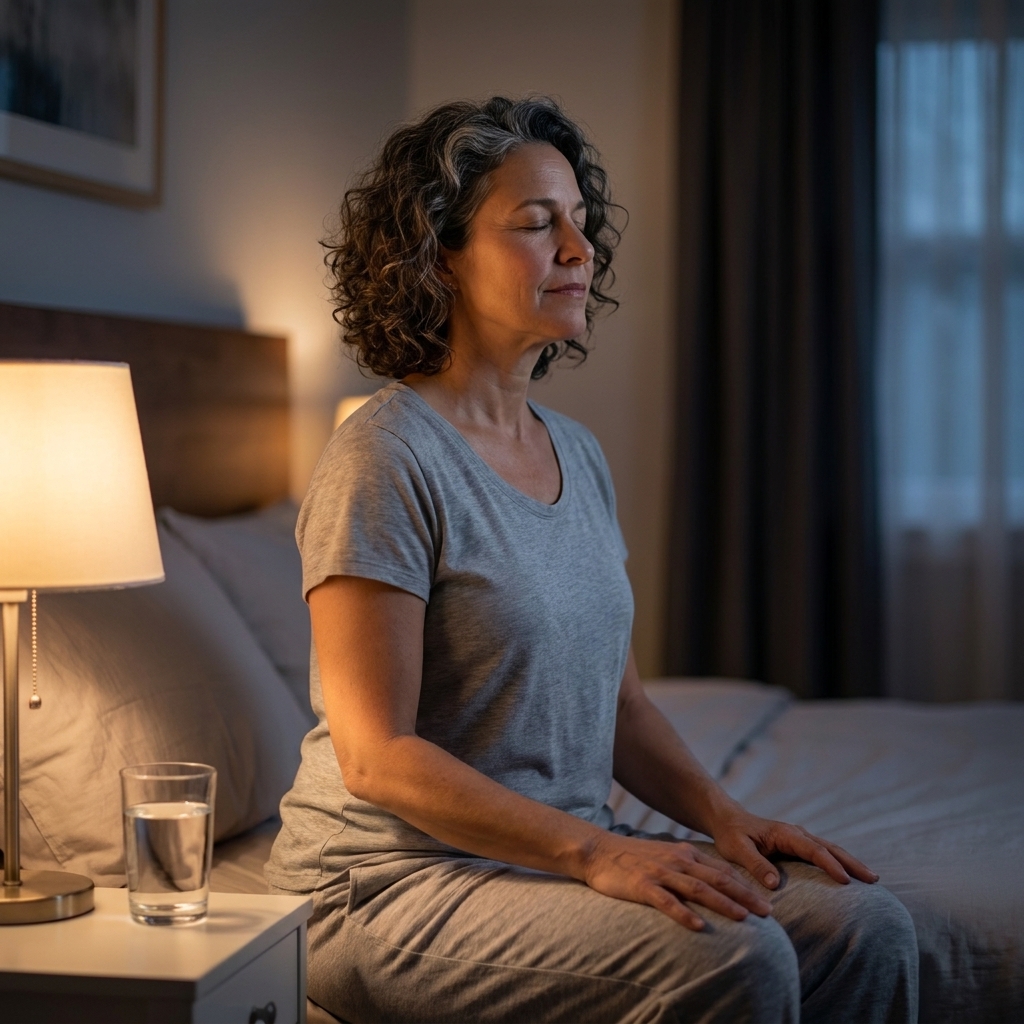
Diaphragmatic breathing encourages deeper, steadier breaths and can reduce the shallow upper-chest breathing pattern that often shows up with stress. This is a foundational skill, and it is wonderfully boring in the best way. Boring is a compliment at bedtime.
How to do it
- Place one hand on your chest and one on your belly.
- Inhale through your nose for about 3 to 4 seconds, aiming for your belly hand to rise more than your chest hand.
- Exhale slowly through your nose or mouth for about 4 to 6 seconds.
- Continue for 2 to 5 minutes.
Common sticking point
If you feel like you cannot belly breathe, it often helps to bend your knees while lying down, or to sit slightly reclined with support behind your back. Also, do not force your belly outward. Think of your lower ribs expanding softly like an umbrella opening.
Best for: general wind-down, tension in the shoulders and jaw, rebuilding a calmer baseline over time.
Technique 4: Box breathing
Box breathing adds structure: inhale, hold, exhale, hold, all for the same count. It can be especially helpful if your mind wants something to focus on besides trying to fall asleep.
How to do it
- Inhale through your nose for 4.
- Hold for 4 (soft hold, no straining).
- Exhale through your nose (or mouth) for 4.
- Hold for 4.
- Repeat for 4 to 6 rounds.
Make it more sleep-friendly
- If you feel more alert, switch to 3-3-4-3 or drop the holds completely and do 4 in, 6 out.
- Try imagining the corners of a square as you move through each phase. Simple, not performative.
Best for: mental chatter, restlessness, the urge to check your phone.
Pick one for tonight
If decision fatigue hits at night, use this quick match-up:
- Heart racing or sudden stress: Physiological sigh (3 to 5 rounds).
- Racing thoughts: 4-7-8 (4 rounds, modify holds if needed).
- General tension and shallow breathing: Belly breathing (2 to 5 minutes).
- Busy mind that needs structure: Box breathing (4 to 6 rounds, or adjust counts).
If you try one and it feels off, that is useful information, not failure. Switch to a gentler pattern and keep your breath comfortable.
A simple 5-minute routine
Here is a no-fuss sequence I often recommend when someone wants a repeatable plan:
- 1 minute: Belly breathing, easy pace.
- 1 minute: Physiological sigh, 3 rounds spaced out.
- 2 minutes: 4-7-8, 3 to 4 rounds (modify holds as needed).
- 1 minute: Slow breathing with a longer exhale, such as 4 seconds in and 6 seconds out.
Then turn the lights out. If you are not sleepy yet, repeat the last minute for another 2 to 3 minutes, or return to easy belly breathing.

Common questions
How fast does it work?
Some people report a noticeable shift within about 30 to 90 seconds, especially with the physiological sigh. For others it is subtler and builds over a few minutes. If nothing changes immediately, that does not mean it is not working. You are practicing regulation, not forcing sleep.
Can this help with insomnia?
It can help reduce arousal and anxiety that feed insomnia, and it can become a consistent cue that your body associates with winding down. If insomnia is persistent, it is also worth exploring the bigger picture, like light exposure, caffeine timing, sleep schedule consistency, and CBT-I strategies.
If sleep problems last more than three months, significantly affect daytime functioning, or come with loud snoring or gasping, it is worth talking with a clinician to rule out issues like sleep apnea and to get targeted support.
What if focusing on breathing makes me anxious?
You are not alone. Try keeping your eyes open, breathing at a normal pace, and focusing on the feeling of your feet in the bed instead of counting. You can also shorten any breath holds or skip them entirely. Comfort comes first.
Nose or mouth?
Nasal breathing is often more calming and naturally slows airflow, but mouth breathing is fine if you are congested. The most important factor is a slow, unforced exhale.
When to be cautious
Breathwork is generally safe for most people, but use extra care with breath holds and very deep breathing if you have significant heart or lung conditions, or a history of fainting. If you are pregnant, or if you have panic disorder or PTSD and feel distressed during breathwork, stick with gentle breathing without holds and consider checking in with your clinician or a qualified therapist.
If you feel dizzy, numb, or tingly, return to normal breathing. That can be a sign you are overbreathing.
One last thing
Falling asleep is not something you can perfectly do. It is something your body allows when it senses enough safety and enough sleep pressure. Breathwork is not about controlling your body. It is about offering it a calmer signal.
Try one technique tonight for two minutes. If it helps, repeat it tomorrow. If it does not, adjust and try a gentler option. That is how you find what actually works for you.